


🍄 Beyond bacteria — the quiet half of your vaginal ecosystem.
For years, women’s vaginal health was explained with one word: bacteria. Probiotics went mainstream, Lactobacillus became a household name, and pH strips sold out online. But a quiet revolution has been unfolding in research labs — and it concerns the other half of your microbiome.
The vaginal mycobiome — the fungal community living alongside your bacteria — may be just as important as the bacteria we’ve spent a decade obsessing over. Vaginal mycobiome support is the new frontier of women’s intimate health.
And understanding it could finally explain the recurring discomfort you’ve been told is “normal.”

Add us as your Preferred Source on Google to see more trusted, evidence-led women’s health content in your search results.
⭐ Select Our Site as a Preferred Source⚡ TL/DR: Quick Summary
The vaginal mycobiome is the fungal community — mainly Candida species — that lives alongside vaginal bacteria. A healthy vagina is not fungus-free; it is a balanced ecosystem where Lactobacillus keeps pH at 3.8–4.5 and fungi stay harmless.
The best vaginal mycobiome support is therefore indirect: named Lactobacillus strains (GR-1, RC-14, L. crispatus), prebiotic fibre like XOS, and cranberry extract — not aggressive “yeast-killing” herbal blends.
For most women, a transparent, third-party-tested multi-strain probiotic plus lifestyle basics beats any single-ingredient “miracle” supplement.
What Is the Vaginal Mycobiome?
The vaginal mycobiome is the collection of fungi that live in the vaginal tract. Where the bacteriome is dominated by Lactobacillus, the mycobiome is typically dominated by Candida species — most commonly Candida albicans.[1]
Here is the part most women are never told: the presence of Candida is not the same as an infection. In a healthy, acidic vagina, Candida simply exists as a low-level coloniser. Symptoms appear when that coloniser is given room to overgrow.
Sequencing studies show the vaginal mycobiome is far less diverse than the bacterial side, and that its composition shifts with hormones, menstruation, antibiotic use, and immune status.[2]

Why Vaginal Mycobiome Support Matters
Roughly 75% of women experience at least one episode of vulvovaginal candidiasis in their lifetime, and a significant minority develop recurrent infections — four or more episodes per year.[3]
Recurrence is the clue that something ecological, not incidental, is happening. Women with recurrent yeast infections often show reduced Lactobacillus diversity and lower protective acidity, which allows fungal overgrowth to return again and again.[4]
This is also why mycobiome research overlaps heavily with broader reproductive health questions — the same immune and microbial balance that protects the vagina also matters during pregnancy and postpartum recovery. If you want context on how infections can affect maternal and fetal outcomes, our guide to the signs and symptoms of TORCH infections is a useful companion read.
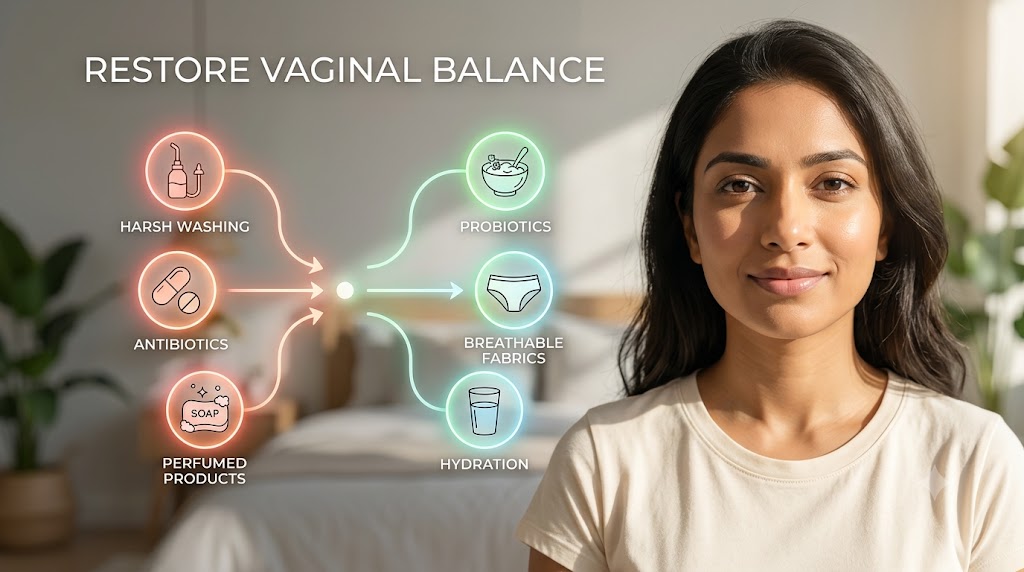
Supporting the ecosystem — rather than repeatedly attacking it — is the more durable strategy.
Mycobiome vs. Probiotics: Which Is Better for Women’s Vaginal Health?
This is the question readers ask most, and the honest answer is that it is a false choice. Probiotics and mycobiome support are two sides of the same coin.
| Feature | Probiotics (Bacteriome) | Mycobiome Support |
|---|---|---|
| What it targets | Live Lactobacillus bacteria | Fungal balance (mainly Candida) |
| Main mechanism | Lactic acid production, pH 3.8–4.5 | Indirect — depends on bacterial acidity |
| Delivery format | Oral capsules, vaginal suppositories | Usually achieved through probiotics + prebiotics |
| Evidence strength | Strong (meta-analyses available) | Emerging (sequencing-based studies) |
In practical terms: probiotics are the tool, mycobiome balance is the outcome. When Lactobacillus thrives, Candida is kept in check without any antifungal intervention at all.[1]
If you are also rebuilding your overall nutritional baseline, it helps to think beyond the vaginal tract. Our breakdown of what the best plant-based omega-3 supplement actually delivers explains how systemic inflammation and immune signalling influence mucosal health everywhere in the body.
How to Choose the Best Women’s Microbiome Supplement
1. Demand Named Strains
“Lactobacillus blend” tells you nothing. Look for specific, clinically studied strains: L. rhamnosus GR-1, L. reuteri RC-14, L. crispatus, and L. gasseri.[4]
2. Check the CFU Count and Shelf Stability
Vaginal-focused formulas typically range from 1 billion to 50 billion CFU. Just as important: does the label guarantee potency at expiry rather than at manufacture?
3. Look for Prebiotics, Especially XOS
Xylooligosaccharides (XOS) feed beneficial bacteria and improve probiotic survival through the gut. A synbiotic — probiotic plus prebiotic — usually outperforms a probiotic alone.[5]
4. Add Cranberry for Urinary Support
Cranberry extract is the most researched botanical for urinary tract support. Vaginal and urinary health share anatomical territory, so combined formulas make practical sense.
5. Insist on Third-Party Testing
Independent verification confirms the strains and CFU counts printed on the label actually exist in the bottle.[5]
6. Be Cautious With “Yeast-Killing” Herbal Blends
Aggressive antifungal herbals can flatten the ecosystem you are trying to restore. Balance, not scorched earth, is the goal.
🔥 Our Top Picks: Vaginal Mycobiome Support Supplements
If you want to stop guessing and start supporting your ecosystem with a clinically grounded formula, these are the two we recommend most often. Both are designed around Lactobacillus strains that maintain acidic vaginal pH — the single most important lever for mycobiome balance.
Multi-Strain Women’s Microbiome Support
Formulated for vaginal pH balance, yeast balance and daily feminine comfort.
Daily Feminine Probiotic + Prebiotic
Built for women who want transparent strains and third-party-tested quality.
Why these two? Because they respect the ecosystem instead of attacking it. Named strains, sensible CFU counts, and no “miracle cure” hype — just consistent, research-aligned support for the balance your body is already trying to maintain.
Q&A: Mycobiome Support Questions Answered
Best Mycobiome Support for Women: Emerging Science on Vaginal Microbiome Health
Emerging science shows the vaginal mycobiome is dominated by Candida species in many women. When Lactobacillus levels stay high and pH stays acidic, Candida remains a harmless coloniser. Mycobiome support means protecting that bacterial–fungal balance rather than trying to sterilise the vagina of fungi.[1]
Best Vaginal Mycobiome Support: What Women Should Know Before Choosing a Supplement
Check four things first: named Lactobacillus strains with clinical data, transparent CFU counts, third-party testing, and whether the formula includes prebiotics such as XOS. Avoid products promising to “kill yeast” with aggressive herbal blends — over-suppressing fungi can disrupt the very balance you are restoring.[5]
Mycobiome vs. Probiotics: Which Is Better for Women’s Vaginal Health?
They are not competitors. Probiotics supply live Lactobacillus bacteria; the mycobiome is the fungal side of the same ecosystem. Probiotics support the mycobiome indirectly by producing lactic acid and keeping pH at 3.8–4.5, which prevents Candida overgrowth. For most women, a well-formulated Lactobacillus probiotic is the practical route to mycobiome support.[4]
Best Supplements for Vaginal Microbiome Support: Beyond Bacteria to the Mycobiome
The best supplements go beyond raw CFU counts. Look for multi-strain Lactobacillus formulas, prebiotic fibre, cranberry extract for urinary support, and vitamin D or zinc where fungal balance is a concern. Strains such as GR-1, RC-14 and L. crispatus have the strongest evidence for maintaining an acidic vaginal environment.[3]
Best Women’s Microbiome Support for Vaginal Health: The New Mycobiome Science
The new mycobiome science reframes recurring yeast issues as an ecological problem, not a hygiene problem. DNA-sequencing studies show women with recurrent vulvovaginal candidiasis often have less diverse Lactobacillus communities. Restoring bacterial diversity and acidity is therefore the most researched long-term strategy for comfort.[2]
Best Probiotics & Mycobiome Support for Women: What the Latest Research Reveals
Recent reviews and meta-analyses report that probiotic supplementation significantly reduces vaginal pH and lowers recurrence rates of bacterial vaginosis and yeast infections when used alongside standard treatment. Benefits are strain-specific, so named strains matter more than high CFU numbers alone.[4]
Disclosure & Disclaimer
Disclosure: This article contains affiliate links. If you purchase through these links, we may earn a small commission at no additional cost to you. This supports our mission of publishing free, research-informed women’s health content. We only recommend products whose formulation aligns with the evidence discussed above.
Disclaimer: This article is for educational purposes only and is not a substitute for professional medical advice, diagnosis, or treatment. The vaginal mycobiome is an emerging field, and research is ongoing. Always consult a qualified healthcare provider before starting any supplement — especially if you are pregnant, breastfeeding, immunocompromised, taking medication, or experiencing persistent vaginal symptoms. Do not use this information to self-treat a suspected infection. Individual results vary.
P.S. Your body is not broken — it is an ecosystem asking for the right conditions. Stop fighting your microbiome and start feeding it. Balance is not a luxury; it is your birthright. 💚
References
- Drell T, et al. The vaginal mycobiome and its role in women’s health. Frontiers in Microbiology / NCBI PMC. https://www.ncbi.nlm.nih.gov/pmc/
- Bradford LL, Ravel J. The vaginal mycobiome: a contemporary perspective on fungi in women’s health and diseases. Virulence. https://pubmed.ncbi.nlm.nih.gov/
- Vulvovaginal Candidiasis — STI Treatment Guidelines. Centers for Disease Control and Prevention (CDC). https://www.cdc.gov/std/treatment-guidelines/
- Systematic review and meta-analysis: probiotics for vaginal pH and recurrent vaginitis outcomes. NCBI PMC, 2026. https://www.ncbi.nlm.nih.gov/pmc/
- Probiotics: What You Need To Know. National Center for Complementary and Integrative Health (NCCIH). https://www.nccih.nih.gov/health/probiotics-what-you-need-to-know
- Reid G, et al. Oral Lactobacillus rhamnosus GR-1 and L. reuteri RC-14 for restoration of vaginal flora. FEMS Immunology & Medical Microbiology. https://pubmed.ncbi.nlm.nih.gov/







Leave a Reply